Netelia
Netelia
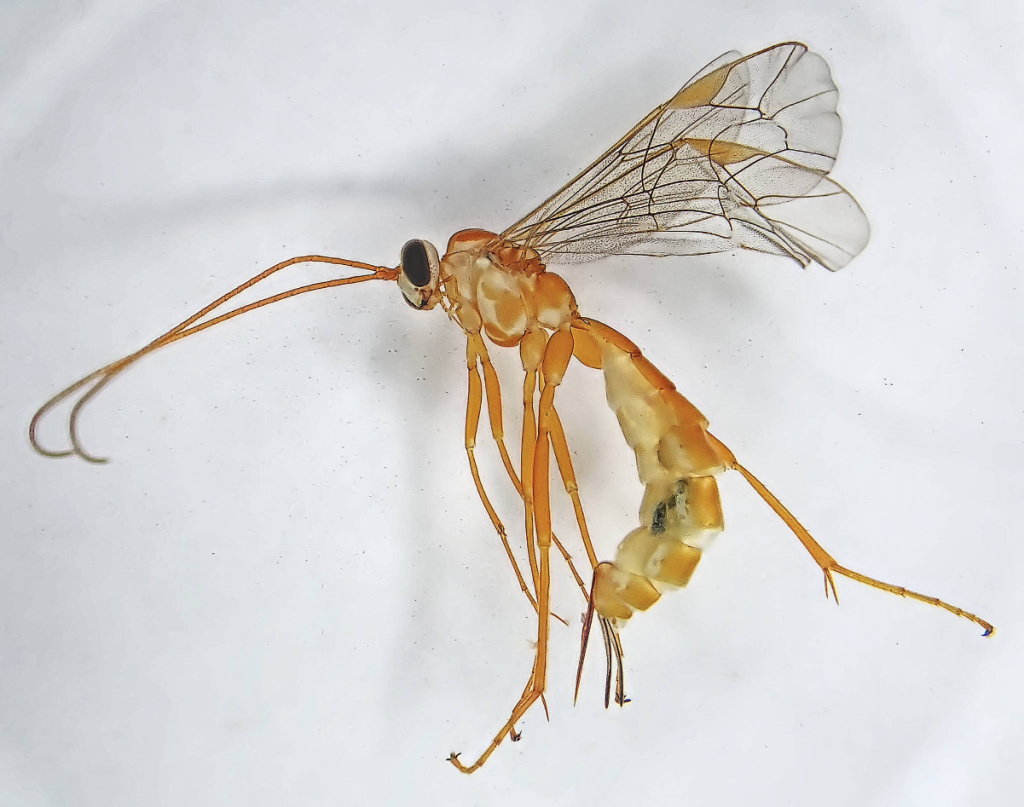
Colour pale reddish-orange to brownish-yellow, often with yellowish markings on the face and thorax. Medium to large ichneumons with forewing lengths typically ranging between 6 and 2 mm. A primary identification feature for the genus is that the mandibles are twisted approximately 90 degrees near the tip. Wing venation - areolet present (unlike similar nocturnal ichneumonids (e.g., Ophion), Netelia forewings feature a small, closed, triangular or pentagonal areolet formed by veins 2r-m and 3r-m). Vein Rs is strongly bent as it approaches vein 3r-m. 2m-cu: Positioned distal to vein 2rs-m. Long, slender legs adapted for clinging to foliage at night.
Pectinate claws: the tarsal claws are comb-like, featuring a row of close-set fine teeth along the inner edge. Females possess a distinct, moderately exposed ovipositor that is roughly 0.3 to 0.7 times the length of the hind tibia. This contrasts with short-ovipositor subfamilies like Ophioninae.

Unless identified by a recognised expert, a photo is required and the specimen should be examined with a microscope. In the comments box, state the key or ID method used and describe the size and identifying characters.
Netelia species are predominantly nocturnal or crepuscular. They are commonly attracted to artificial light sources, moth light-traps, and street lamps.
Netelia species are primary koinobiont endoparasitoids of caterpillar larvae, mainly targeting families such as Noctuidae, Geometridae, Notodontidae, and Sphingidae (Lepidoptera).
Common.
Common but under recorded.
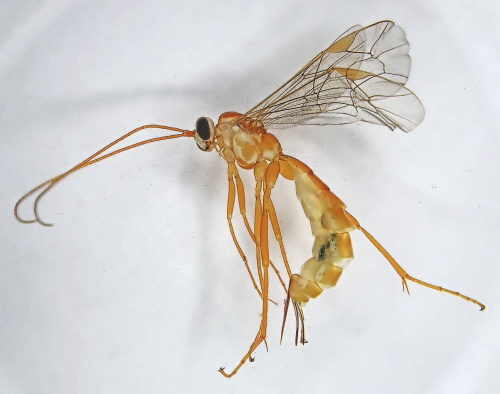 Graham Calow
Sapcote, Harecroft Crescent
22 September 2026
specimen examined
Leicestershire & Rutland Map
Enter a town or village to see local records
MAP KEY:
Yellow squares = NBN records (all known data)
Coloured squares = NatureSpot records: 2025+ | 2020-2024 | pre-2020
UK Map
Additional images
No additional images available for this species.